
Every Crash Felt Like The End. None Of Them Were.
History's Most Expensive Investing Mistake Is Believing "This Time Is Different". June 09, 2026.

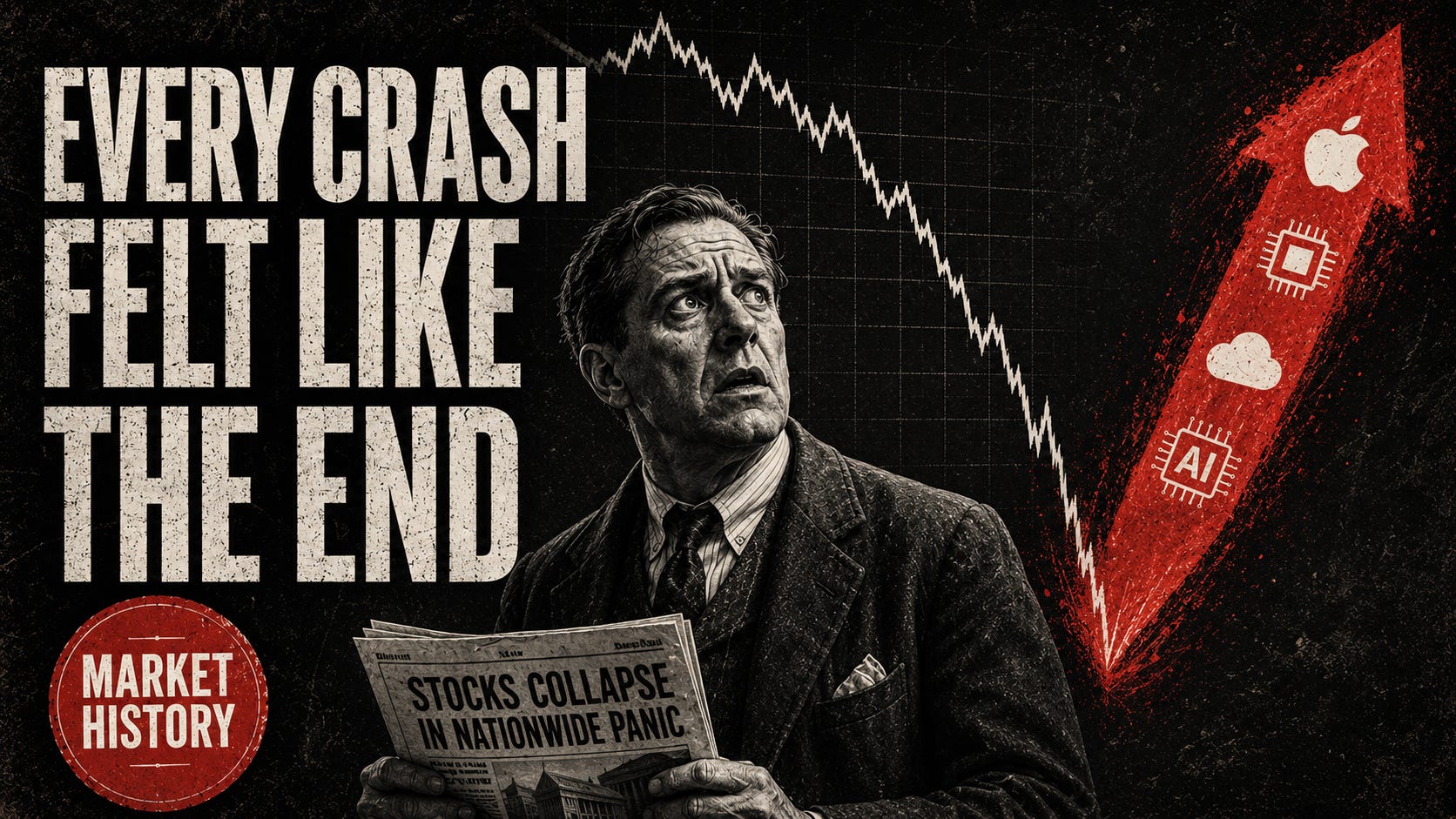
Research: Illustration
Date: June 09, 2026
This time is different?
In March 2009, investors thought the financial system was collapsing.
In March 2020, investors thought the global economy was shutting down indefinitely.
In 2000, many believed the internet was little more than a speculative bubble.
Looking back, those fears seem exaggerated.
At the time, they felt completely rational.
That’s the uncomfortable truth about investing. Every major market crash feels permanent when you’re living through it. The headlines are convincing. The fear feels justified. And yet, history shows that markets have an extraordinary ability to recover, adapt, and eventually move higher.
Almost none of the crises that felt like “the end” actually were.
Know someone worried about the next market crash? Share this article with them.
The Market’s Favorite Trick
One of the most fascinating things about investing is that the stock market often looks completely broken right before it begins creating enormous wealth.
Every crisis arrives with a compelling story.
Banks are failing.
Technology is dead.
Consumers have stopped spending.
The economy will never recover.
I’ve seen some version of these arguments throughout my investing journey. The details change, but the psychology never does. Fear convinces investors that the future will look exactly like the present.
It rarely does.
Companies innovate. New industries emerge. Business models evolve. The investors who stay patient are often rewarded, while those who panic usually miss the recovery.
History has repeated this lesson many times.
1987: The Day Wall Street Panicked
On October 19, 1987, the U.S. stock market suffered one of the worst days in its history.
The Dow Jones Industrial Average fell more than 22% in a single session.
Imagine waking up to that headline.
Many investors genuinely believed something had broken inside the financial system. The media coverage was relentless. Fear spread quickly.
Yet within two years, the market had recovered its losses and moved to new highs.
What followed was one of the most powerful economic expansions in modern history. The following decade helped create giants such as Microsoft, Intel, and Cisco.
The crash felt like the end.
In reality, it was the beginning of a completely new chapter.
2000: The Internet Bubble Bursts
The dot-com crash was brutal.
The Nasdaq lost nearly 80% of its value. Thousands of companies disappeared. Investors lost fortunes.
Many concluded that the internet itself had been massively overhyped.
In one sense, they were right.
Most of those companies deserved to fail.
But the technology didn’t fail.
The internet went on to reshape the global economy.
What’s remarkable is that some of the greatest investment opportunities of the next twenty years appeared right in the middle of that wreckage. Companies like Amazon, Apple, and Google emerged from that period to become some of the most valuable businesses in history.
At the time, very few investors wanted to own them.
Fear is usually loudest when opportunity is greatest.
2008: The Crisis That Was Supposed To End Capitalism
Few periods felt darker than the Global Financial Crisis.
Major banks failed.
Housing prices collapsed.
Credit markets froze.
The S&P 500 lost more than half its value.
For the first time in decades, many investors weren’t asking whether stocks would recover. They were asking whether the financial system itself would survive.
I still remember how hopeless the mood felt.
Then something remarkable happened.
The recovery began.
Over the next decade, investors witnessed one of the strongest bull markets ever recorded. Companies like Apple, NVIDIA, Netflix, and Salesforce created extraordinary wealth for shareholders.
The investors who focused on quality businesses instead of headlines were rewarded far beyond what most people thought possible in 2009.
The Biggest Winners Often Emerge When Fear Is Highest
Every week I publish research on stocks, AI trends, and emerging companies that could become the next generation of market leaders.
Join The WalletInvestor Newsletter and never miss an analysis.
2020: The Fastest Crash In Modern History
The COVID crash happened so quickly that many investors barely had time to react.
The S&P 500 fell more than 30% in a matter of weeks.
Flights stopped.
Offices emptied.
Entire economies shut down.
Nobody knew what would happen next.
For a brief moment, it felt as if the world had pressed pause.
And yet markets recovered even faster than they fell.
The next generation of winners emerged from the chaos. Companies like Tesla, NVIDIA, Palantir, and CrowdStrike became some of the defining stocks of the decade.
The lesson was familiar.
The headlines were terrifying.
The opportunity was enormous.
What Investors Consistently Get Wrong
Most investors believe the challenge is predicting crashes.
History suggests otherwise.
Crashes are inevitable.
Recessions are inevitable.
Bear markets are inevitable.
The real challenge is identifying the businesses that emerge stronger afterward.
The biggest fortunes are rarely built by perfectly avoiding downturns. They are built by recognizing transformational companies while everyone else is focused on fear.
That was true after 1987.
It was true after 2000.
It was true after 2008.
And it was true after 2020.
The Question That Matters Today
The most important question isn’t whether another correction will happen.
At some point, it will.
The real question is this:
Which companies will become the next Amazon, Nvidia, or Apple during the next decade?
Every major crash in history eventually produced a new generation of market leaders.
The investors who found them early changed their financial future.
The investors who focused only on the crisis missed the opportunity.
Wall Street doesn’t win because crashes never happen.
Wall Street wins because innovation never stops.
New technologies emerge. New industries are built. New companies solve problems that didn’t exist a decade earlier.
And if history is any guide, somewhere inside today’s AI boom, technological disruption, and market uncertainty, the next generation of extraordinary companies is already being built.
The challenge is finding them before everyone else does.
One Question For Readers
Which company do you think could become the next Amazon, Nvidia, or Apple over the next decade?
Leave a comment below. I’m curious which names investors are watching today.
Enjoyed This Article?
Every week I publish:
✓ Deep stock analysis
✓ AI winners and losers
✓ Market outlooks
✓ Long-term investing ideas
✓ Undervalued opportunities
Join thousands of investors already reading The WalletInvestor Newsletter.